
neuromodulation.
Decades of neuroscience research have shown that rhythmic sensory stimulation can evoke a state shift in neural and nervous system responses.
We work to advance this field of knowledge and build the next generation of intelligent neurotechnology.
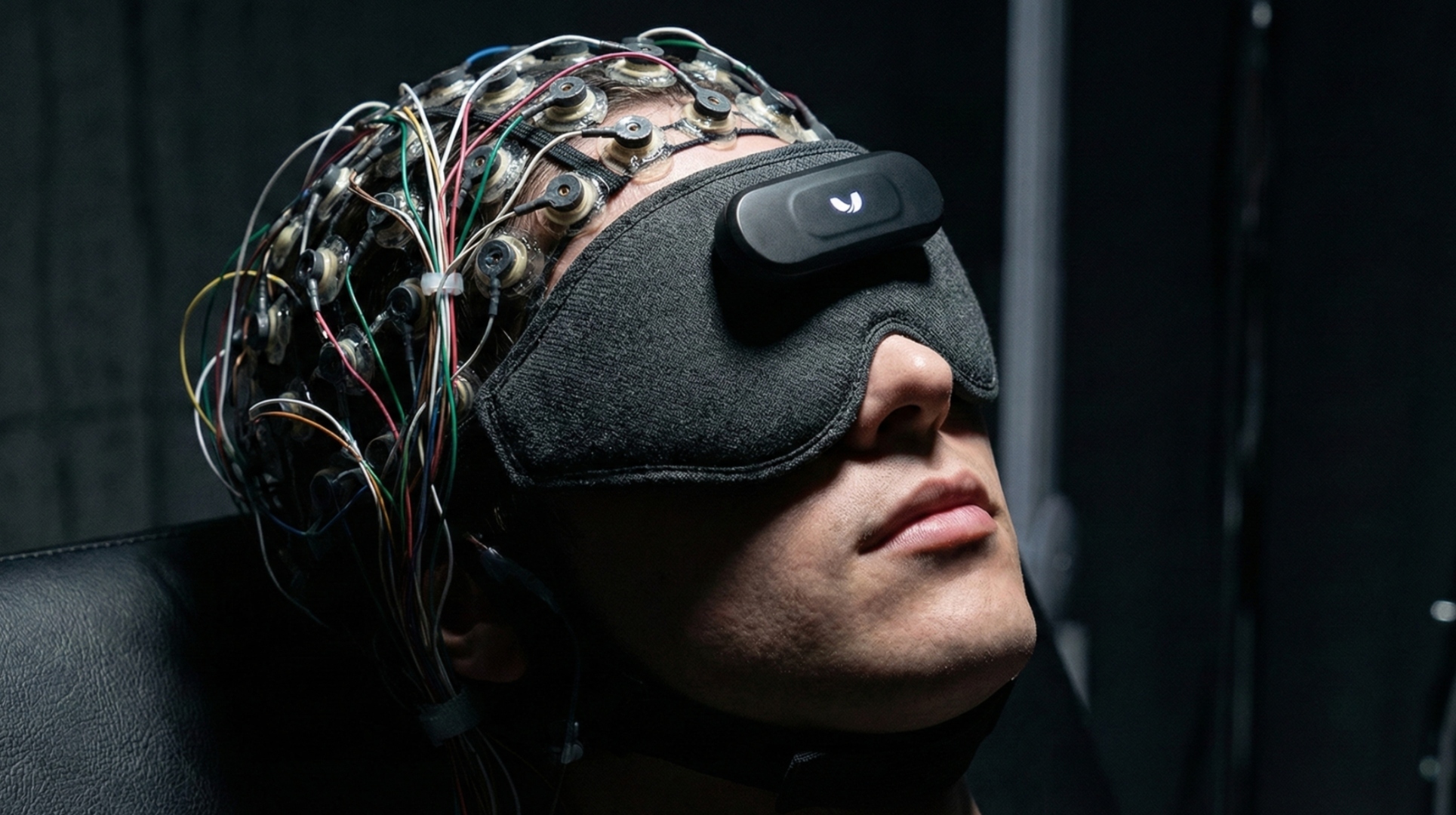
Domayn Mask delivers precision-engineered light and sound pulses providing a stable sensory signal. Cortical systems in the brain naturally synchronize with this signal — a phenomenon called steady-state visual evoked potential (SSVEP), measurable in EEG.
In our studies, we observe the autonomic nervous system shifting toward parasympathetic activation as the brain entrains to the stimulus—lower arousal and readiness for sleep and recovery. We measure this through HRV: increases in RMSSD and SDNN, reductions in LF/HF ratio.
In our studies, these biomarker shifts are aligned with real behavioral change: falling asleep faster, feeling calmer and more at ease, or —with alertness sessions— improved focus.
Domayn Mask is a consumer wellness device, not a medical device. These observations are from early exploratory research. IRB-approved clinical studies planned for 2026.
Does the mechanism actually work? We ran a controlled in-lab exploratory study measuring subjective and physiological responses to our flagship sleep session.
Want to learn more about our exploratory study? Contact us to request the study report.
Important Context
This is not an IRB-approved clinical study. It is an early exploratory effort for internal research and validation purposes. Everything reported here represents our measurements and observations only. None of it is being positioned as peer-reviewed science or clinical/therapeutic claims.
Power spectrum dominated by beta (alert, aroused).
fell asleep or felt sleepy during session (self-reported, n=75)
mean pre/post VAS change (self-reported, n=75)
want to use again (self-reported, n=75)
Early exploratory data from controlled in-lab sessions. These are observational measurements, not peer-reviewed findings.
We are developing research partnerships with academic and clinical institutions. We do not disclose partners until research is published — but these are the areas we're actively working on.
Interested in research collaboration? Contact us.
Investigating how precisely timed AVS sessions may influence sleep stage transitions, circadian rhythm alignment, and overall sleep architecture quality.
Studying the mechanisms through which entrainment sessions may shift autonomic balance toward parasympathetic dominance and self-reported changes in perceived stress levels.
Exploring beta and gamma entrainment effects on sustained attention, working memory, and cognitive task performance in controlled settings.
Collaborating with academic and clinical institutions to investigate AVS-based sensory technology across a range of neurological research contexts, including neurodevelopmental and neurodegenerative conditions.
All stimulus parameters fall within established IEC photic safety limits. We never push beyond what the evidence supports. User wellbeing is non-negotiable.
We report what we find, not what we want to find. Pilot data is reported as pilot data. We don't overpromise, and we stay one step behind the evidence.
We are committed to publishing our findings, sharing our methodology, and contributing to the broader scientific understanding of AVS-based neuromodulation.